Small Fry

small fry pic

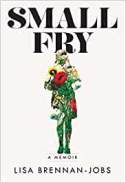
Small Fry by Lisa Brennan Jobs is another memoir set in the Silicon Valley, albeit of a different kind.  The book is not about startups or working for Bay area entrepreneurs but rather it is about relationships.  Complex father-daughter and mother-daughter bonds have been skillfully dissected to their bare bones for an outsider to lean in and examine. 

Lisa Brennan Jobs is the first daughter of Steve Jobs, the founder of Apple.  Initially disowned by Steve, she later finds herself swinging between two highly polarized worlds inhabited by her parents.  Her mother Chrisann is a hippie artist, always short on money and her father is well, a multimillionaire.  By the time Lisa is seven, her mother and she have moved thirteen times. Lisa once walks in on her mother squatting on top of the toilet seat.  “I learned that in India,” she said. “It’s a better position.  Close the door”.  On the other hand, her father lives in a sprawling mansion and he has no idea how many rooms there are as he has not set foot in most of them.

Amidst mounting arguments with her mother when she is in middle school, Lisa moves in full time with her father and hopes for her life to turn around, to be accepted into the family.  Instead, she comes face to face with the contrasting qualities in her eccentric father who alternates between being frugal and generous, mean and wonderful.  Lisa feels incredibly lonely and anxious amidst her father and stepmother and ends up breaking a glass every evening at dinner and wonders whether they had made a mistake in allowing her to live with them.

Lisa finally makes her way to Harvard, faking Steve’s signature on the application.  But her freedom is clipped when Steve stops paying for her tuition in her final year.  She is bailed out by her neighbors, who in turn are deeply hurt when Lisa invites Steve to her graduation.  In the near climatic scene in the book, however, Steve profusely apologizes to Lisa for not being there for her and often repeats that he owes her one.  The final moments between Steve and Lisa are tender and touching.

Steve used to call Lisa “Small Fry”: “Hey, Small Fry, let’s blast.  We’re livin’ on borrowed time.”  Fry is the term used for young fishes who are thrown back into the sea to give them more time to grow. The key takeaways from the book are that a) you can’t change your parents and b) you can’t buy your way into relationships.

But this book nearly didn’t happen. When Lisa is a senior in high school, she feels bereft of a story to tell as her aunt Mona has published a fictional book with a character named Jane, who is based on Lisa.  “Reading her book, I felt there would be nothing left for me to write about.” Further when Steve is sick with cancer, he once asks Lisa, “Are you going to write about me?” “No”. “Good”, he replies. But in putting out her version of events, Lisa has pulled off a literary feat and produced a compelling read, one that is bound to make the reader look at Steve Jobs in a different light.

Chaos Monkeys

chaos monkeys

Lately I have been on a binge fest, devouring memoir after memoir couched in startupland. And Chaos Monkeys by Antonio Garcia Martinez has been the latest kill. 

Martinez is a physics PhD dropout from Berkeley who leaves a job at Goldman Sachs in the wake of the 2008 financial crisis to join a an adtech startup in the Silicon Valley.  From there, he ventures into his own startup with help from the accelerator Y-Combinator.  Eventually he sells the company to Twitter and transitions into the role of a Product Manager at Facebook. Martinez has provided a detailed autobiographical account of his entire career journey in the book.

A few pages in though, I started wondering how this book had managed to make it into the New York Times Bestseller’s list and I ploughed through much of this five hundred page tome trying to figure out the answer.  In the end, I emerged disappointed and exhausted.  While Anna Wiener used wit and Dan Lyons employed satire to produce entertaining tell all accounts, Martinez has relied on a disparaging tone that serves mostly to vex the reader and generate dislike for the narrator.

Martinez has devoted swathes of the book to his obsession, a product called FBX, which he championed while working at Facebook. Reading page after page on the merits of FBX really isn’t engaging unless you are into advertising technology.  This disquisition really needed to be tempered.

Another thing that I did not like was the fact that Martinez made no attempt to disguise the identity of the Indian origin CEO of the startup where he was employed.  He openly names this person and displays his contempt for him using words like sycophant and tyrant, going to the extent of stating: I’ve probably never hated one man so much, other than my father.  Using a pseudonym or a nickname would have been a better technique to deal with this matter.

The book does have its moments though.  Martinez is interviewing at Facebook when he goes to the bathroom to relieve himself.  The sound of laptop keyboard clicking emerges from one of the stalls.  From the cadence, it dawns on Martinez that the person inside the stall is writing code while on the pot.  This level of geekiness manages to startle even a tech veteran such as Martinez, though it does not deter him from signing on the dotted line at Facebook.

While reading these memoirs, I feel like a curious kid observing, with nose pressed against the window, the inner workings of tech startups and I can’t help but make comparisons with the corporate world.  It seems that the cast and culture are different but the narrative is similar – desire and insecurity collude to manifest themselves in a variety of shenanigans and wiles.  As the author says, “Sure, it’s no worse than traditional industry or politics, but certainly no better either.”

Overall, this tell all memoir is just so-so.  I would advise you to read it if you are interested in ad tech or are planning to audition for a role at Facebook, otherwise you can safely give it a pass.

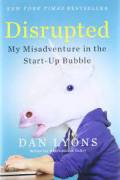
Disrupted

disrupted

Last week a friend said to me: Look, if you liked Uncanny Valley, then you will love Disrupted.  So I picked up the memoir Disrupted: My misadventure in the start-up bubble by Dan Lyons.  Dan is a fifty-two year old veteran journalist who joins a start-up called HubSpot.  Instantly, I am reminded of the movie The Intern where an older guy (Robert De Niro) joins a young start-up.  But the similarity ends there. 

Dan is a technology editor at Newsweek when he is unceremoniously dumped after years of service.  He joins Hubspot in the hope of starting over but the dramedy begins on day one when he is stunned to discover that his day-to-day manager is a twenty-something kid with no prior managerial experience.  He is seated shoulder to shoulder with other twenty-somethings in a content factory and finds himself increasingly isolated and alienated in a company where an executive brings in a teddy bear to stand-in for a client in the management meetings and employees are constantly “graduating” i.e. getting fired at short notice.  He hopes the situation will improve when a new manager arrives on the scene but unfortunately, this person turns out to be erratic and unpredictable in his behavior.  Things turn truly ugly when Dan announces that he will be publishing a book on his time in HubSpot after leaving the company.  Two senior executives are caught employing aggressive tactics in an effort to procure the manuscript and one of them is fired by the board.  The FBI step in to investigate the matter. 

Dan is a seasoned satirist and wearing an anthropologist’s hat, he has penned a page turner that not only chronicles his time at the startup but also casts a critical eye over the bubble economics and excesses that prevail in the new economy.  The book is full of incidents, both hilarious and cruel, that tempt you to believe that they are fictional but sadly, are real and you marvel at the fact that millions of dollars of venture capital funding have gone into propping up staggering levels of ridiculousness.  Dan quotes a line by W.C Fields that is sure to stay with me: If you can’t dazzle them with brilliance, baffle them with bullshit. 

Sweet.

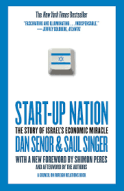
Start-up Nation

startup nation

I was eager to read the book Start-up Nation written by Dan Senor and Saul Singer. In my interactions with Israeli businessmen, I have found them to be direct, assertive, and knowledgeable.  In the book, I discovered the word to label their particular attitude – chutzpah. The book reveals that it is this very chutzpah combined with the antihierarchical culture promoted in the military service that makes it okay for an Israeli to ask his superior:  Why are you my manager? why am I not your manager?  I nearly did a double take when I read this as I know of a friend who once in utter frustration asked his boss in an Indian company a variant of this question: Who made you my manager? Unfortunately for my friend, the challenge did not go down well with his manager; rather it served as a guillotine chop on his career in the company. 

But such cultural differences only partly explain Israel’s success and its transformation from a small, isolated country into a global hub of high-tech innovation and entrepreneurship. The book brilliantly demystifies the development of Israel into a centre of innovation through rich examples, anecdotes and historical context.  The combination of military and civilian experiences (the term used is mashup), an immigrant mindset, a culture of acceptance of failure, the constant need to counter threat to survival and strong government policies have all contributed to make Israel an economic powerhouse. 

There are many lessons that India and other countries can learn from the Israeli model.  The establishment of Startup India is indeed a step in the right direction.  But for Indian startups to really take off, the Indian mother needs to teach her children that that is okay to take risks.  It is only by embracing failure rather than stigmatizing it that a true startup culture will flourish in any society.

Uncanny Valley

uncanny valley

A coming of age story of a lady who lands herself a role in the startupland.  It deals with the anxieties, panic, struggle of a nontechnical woman working in tech startups.  The author skillfully weaves in her commentary on the startup culture in the Silicon Valley and its impact on the city of San Francisco while narrating her personal journey of four years in tech. 

They say that fish cannot see water but Anna Wiener is an outsider –  to the city as well as the tech world  – and hence is able to make acute observations of the startup lifestyle and its inherent shortcomings. 

The last few pages of the book descend into what seems like a general rant about the startup ecosystem, its failings and the false perception of the participants that tech and money can solve all of the problems in society.  But still the book holds a mirror to this world and is recommended for anyone seeking to understand the vocabulary and texture of the Silicon Valley.